
A practical framework for improving visibility, strengthening privacy governance, and building DPDPA readiness
Organizations collect and use personal data across multiple business functions—from sales and customer support to HR, finance, marketing, and vendor management. That data may move through websites, applications, spreadsheets, cloud platforms, internal systems, and third-party service providers.
The challenge is that organizations do not always have a complete picture of where personal data originates, why it is used, who can access it, where it is stored, how long it is retained, and how it is eventually deleted.
This is where personal data mapping becomes important.
Data mapping helps connect business processes with the personal data they handle, the systems that support those processes, the parties involved, and the controls that govern the data throughout its lifecycle. It provides a practical foundation for privacy governance and DPDPA readiness.
What is personal data mapping?
Personal data mapping is the structured exercise of identifying and documenting how personal data flows through an organization.
Rather than simply listing databases or applications, an effective data-mapping exercise begins with business activities and follows the data through its lifecycle.
For example, a customer onboarding process may collect a person’s name, contact details, identity information, and other relevant information. That data may then be used for service delivery, stored in a CRM or ERP system, shared with authorized service providers, retained for defined periods, and eventually deleted in accordance with applicable requirements.
Mapping these activities helps an organization understand the relationship between its business processes, personal data, technology environment, and privacy obligations.
Why is data mapping important for DPDPA readiness?
Under India’s Digital Personal Data Protection Act, 2023 (DPDPA), organizations need to understand their personal data processing activities to assess applicable obligations and implement appropriate practices.
Data mapping can help organizations:
- Improve visibility: Identify where personal data is collected, used, stored, and shared.
- Clarify accountability: Establish which business teams own processes and who is responsible for relevant systems and controls.
- Support purpose and notice alignment: Compare actual processing activities with the purposes communicated to individuals.
- Strengthen third-party governance: Identify service providers and other recipients involved in data processing.
- Review retention and deletion: Understand how long data is kept and how deletion is performed and verified.
- Support risk assessments: Identify unnecessary data collection, excessive access, uncontrolled copies, and gaps in governance.
- Improve incident preparedness: Help teams identify the systems, processes, and data potentially affected by an incident.
Data mapping does not, by itself, establish compliance. It provides the visibility needed to make better decisions and implement relevant controls.
A practical six-step framework for data mapping
-
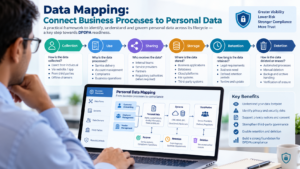
Map business processes and collection points
Start by identifying the business processes that collect or use personal data.
Typical examples include:
- Customer registration and onboarding
- Sales, marketing, and customer support
- Employee recruitment, payroll, and administration
- Vendor and partner management
- Website forms, mobile applications, and customer portals
- Service delivery, billing, and complaint handling
For each process, document how personal data enters the organization—for example, directly from an individual, through a website or application, or from another source where the processing is permitted.
Key question: Which business activity requires this personal data, and how is it collected?
-
Identify the personal data and its purpose of use
Record the categories of personal data involved in each process. Depending on the activity, these may include names, contact details, account information, employment records, transaction details, or identity information.
Then document why the data is processed and whether the actual use aligns with the stated purpose and applicable requirements.
Avoid collecting more information than the process genuinely needs. Unnecessary data increases the effort required to protect, govern, retain, and delete it.
Key question: What personal data is used, and why is it needed?
-
Trace data flows across systems and teams
Personal data rarely remains in one application. It may move between business teams, databases, reporting platforms, email systems, cloud services, and third-party applications.
Document the important data flows, including transfers between systems and the people or teams with access.
Include informal and less visible locations such as spreadsheets, exported reports, shared folders, email attachments, and manual records where relevant.
Key question: Where does the data go after it is collected?
-
Identify third parties and data recipients
Identify external service providers and other parties that receive or process personal data as part of the business process.
Examples may include payroll providers, cloud hosting providers, customer relationship management platforms, communication services, and outsourced support partners.
Record the information shared, the purpose of sharing, the systems involved, and the relevant contractual or governance arrangements. Assess these relationships according to the organization’s applicable legal obligations and risk criteria.
Key question: Who receives or can access the data, and under what arrangements?
-
Document storage locations and retention requirements
Identify where personal data is stored, including business applications, databases, cloud platforms, endpoints, backups, archives, and physical records where applicable.
Determine the relevant retention requirements based on the purpose of processing, applicable law, and other legitimate business requirements. Document how retention periods are implemented and reviewed.
Where data is no longer required for the relevant purpose and there is no applicable reason to retain it, establish an appropriate deletion process.
Key question: Where is the data stored, and how long should it be retained?
-
Validate deletion and assign ownership
A data map should explain not only where data is stored but also how it is removed when required.
Review whether deletion is manual or automated, whether copies exist across connected systems, and how backups and archives are handled. Define a proportionate method to verify deletion, taking into account technical limitations and applicable retention obligations.
Assign a business owner to each mapped process and identify the relevant system or data owner. Establish a review cycle so the map stays current when systems, vendors, or business activities change.
Key question: Who is accountable for keeping the data map accurate and the associated controls effective?
What should a data-mapping register contain?
A practical data-mapping register can begin with the following fields:
| Field |
What to record |
| Business process | The activity involving personal data |
| Business owner | The accountable function or role |
| Personal data categories | Types of personal data involved |
| Source and collection method | Where and how data is obtained |
| Purpose of processing | Why the data is used |
| Systems and storage locations | Applications, databases, platforms, and relevant repositories |
| Internal access | Teams or roles with access |
| External recipients | Relevant third parties and service providers |
| Retention requirements | Applicable retention period or rule |
| Deletion method | How data is deleted or otherwise disposed of |
| Existing controls and risks | Relevant safeguards, gaps, and follow-up actions |
| Last reviewed | Date of validation and next review, where applicable |
The register should be proportionate to the organization’s size, complexity, and processing activities. It should also link to related records—such as privacy notices, vendor assessments, risk assessments, and retention schedules—where useful.
Common data-mapping mistakes to avoid
Mapping only IT systems: A system inventory is useful, but it does not explain the business purpose or how personal data flows between processes.
Ignoring spreadsheets and manual records: Data held outside core applications can be overlooked, creating gaps in visibility and governance.
Treating the exercise as a one-time project: Business processes, integrations, vendors, and applications change. The data map needs periodic validation and updates when significant changes occur.
Failing to establish ownership: Without named process owners, it becomes difficult to confirm accuracy and close identified gaps.
Confusing documentation with implementation: Recording a retention rule is not the same as enforcing it. Organizations must also assess whether the relevant controls work in practice.
How technology can support data mapping
Technology can help organizations discover data repositories, identify potential personal data, maintain inventories, visualize data flows, track ownership, and monitor remediation activities.
However, automated discovery should complement—not replace—business validation. Technology may identify data patterns, but it cannot always determine the business purpose, legal context, intended recipients, or appropriate retention requirements without additional information and review.
A practical approach combines automated discovery where appropriate with structured interviews, process walkthroughs, system-owner validation, and periodic reviews.
Turning data mapping into an ongoing governance practice
The most useful data map is not necessarily the largest or most technically sophisticated one. It is the one that helps the organization make informed decisions.
Start with high-priority processes that involve significant volumes of personal data, sensitive operational dependencies, extensive third-party access, or greater potential impact on individuals. Validate the results with business and technology stakeholders, prioritize the gaps, and assign actions with clear accountability.
Over time, integrate data mapping into new-project reviews, vendor onboarding, application changes, privacy assessments, and periodic governance reviews.
Conclusion
DPDPA readiness begins with understanding how personal data is actually handled across the business—not simply where it is stored.
By connecting business processes to personal data, systems, recipients, retention practices, and deletion controls, organizations can build a more reliable foundation for privacy governance, risk management, and accountability.
The key question is simple: Can your organization trace personal data from the point of collection to its eventual deletion, and identify who is accountable at each stage?
That is a useful starting point for a more structured and sustainable approach to data privacy.
This article is for general awareness and operational guidance. It is not legal advice or a determination of compliance. Organizations should assess their obligations against the applicable law, rules, commencement provisions, and their specific processing activities.
#DPDPA #DataPrivacy #DataMapping #DataGovernance #PrivacyCompliance